
Seamless Steel Pipe Fundamentals: Types, Sizes, Grades, and Sourcing Basics
Seamless steel pipe is a foundation material in many industrial supply chains, but first-time buyers often discover that “seamless” is only one part of the specification. A complete product description should include the manufacturing route, steel grade, outside diameter, wall thickness, tolerance, and even the cross-section shape. This guide explains these fundamentals in plain language and gives real catalog examples, so you can read a supplier data sheet with more confidence and prepare a stronger first inquiry.
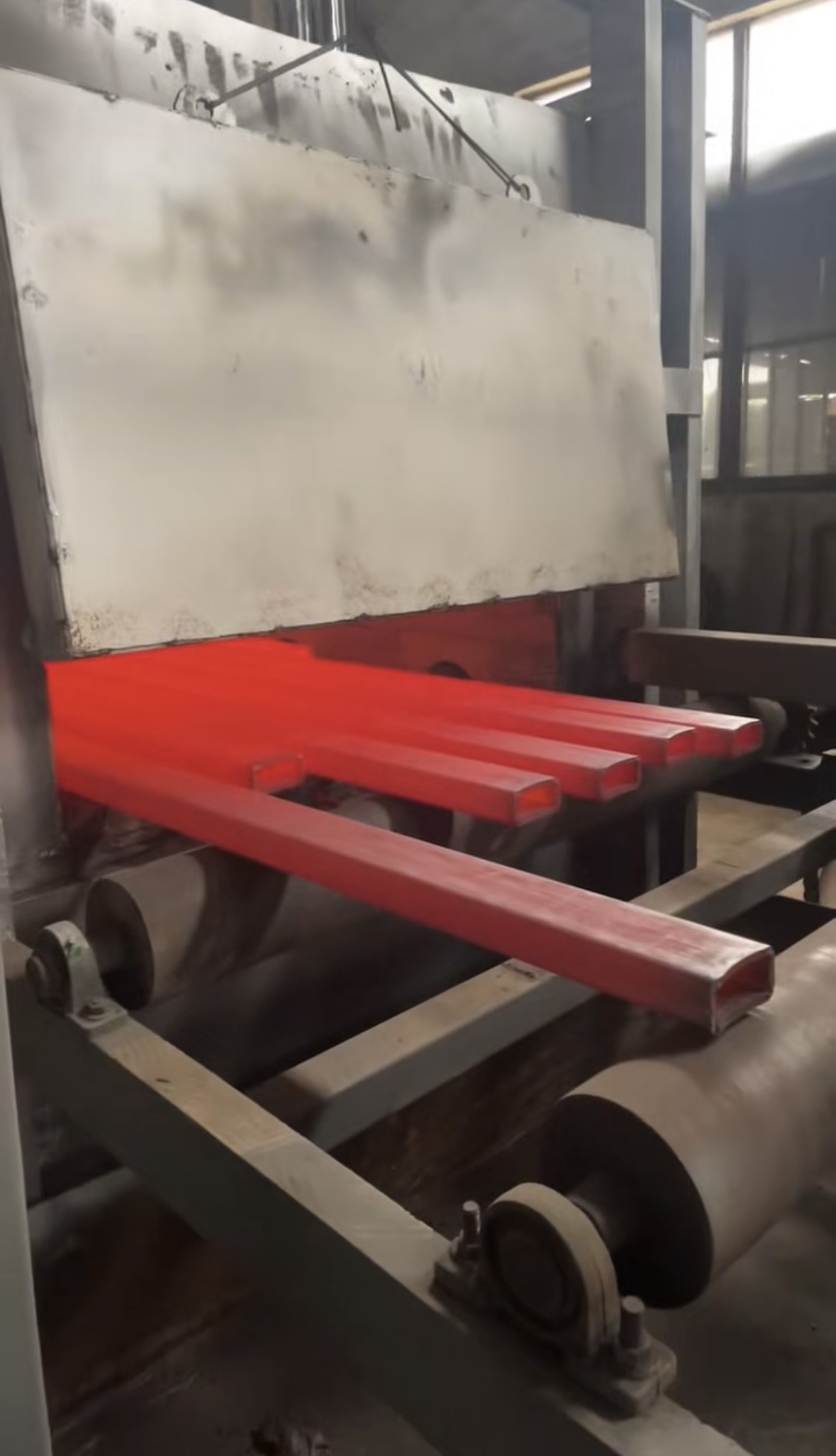
Annealing is part of the seamless tube production process at Fakesi / Wuxi Jiangbo.
The Problem: Not All Steel Pipes Are the Same
From a distance, round steel pipe looks simple. Yet specifying a “seamless steel pipe” without checking the full end-use requirement can lead to expensive mistakes. A welded pipe has a longitudinal or spiral seam that may be unsuitable for high-pressure fluid lines, rotating drive shafts, or precision machining. A hot-rolled pipe may not offer the same dimensional consistency as a cold-drawn product. A round profile may also create excess machining work if the final component needs a hexagonal, triangular, or lemon-shaped cross-section.
The first step in any sourcing project is therefore to define how the pipe will be loaded and processed. Will it contain pressure? Will it transmit torque? Will it be machined into a precision component? Will the final shape already be close to the pipe profile or will the outer and inner surfaces require significant material removal? These answers determine whether a standard round pipe is enough or whether you need a precision seamless steel pipe or a special-shaped tube.
Seamless Steel Pipe: Industry Background
Seamless pipe demand remains broad across industries such as machinery manufacturing, automotive components, petrochemical engineering, power generation, agricultural equipment, and mold manufacturing. According to Market Research Future, the global seamless pipe market was estimated at USD 130.76 billion in 2024. China supplies a substantial share of that volume: data compiled by Mysteel and the General Administration of Customs shows that China’s seamless steel pipe export volume reached 5.72 million tons in 2024, and China accounts for roughly 60% of global seamless pipe production.
Carbon steel is still the dominant material category, representing approximately 78% of the global steel pipe market in 2026 projections. Within the advanced segment, cold-drawn seamless steel tubes are projected to reach a market value of USD 26.14 billion by 2035, with a CAGR of 16.57%. This background matters to industrial buyers because it shows why many global sourcing teams consider Chinese seamless steel pipe manufacturers as a primary supply option: the scale is large, the product range is broad, and carbon steel seamless pipe is produced in high volume.
Detailed Solution: Seamless Steel Pipe Families
To make the category easier to evaluate, suppliers divide seamless steel pipe into functional groups. At Fakesi, the product portfolio includes seamless round pipes, precision seamless steel pipes, cold-drawn seamless pipes, thick-wall pipes, thin-wall pipes, large- and small-diameter pipes, hot-rolled pipes, high-pressure pipes, carbon steel pipes, and a wide range of special-shaped seamless tubes.
Seamless Round Pipe and Precision Seamless Steel Pipe
The most common starting point is a round seamless steel pipe. It can be produced by hot rolling or by cold drawing. Hot-rolled seamless pipe is formed at elevated temperature, while cold-drawn seamless pipe is drawn through a die at room temperature to improve dimensional accuracy and surface quality. Cold-drawn products are often described as precision seamless steel pipes or precision bright steel pipes because they are intended for machining and close-tolerance applications.
As a concrete example, the Fakesi seamless steel tube has a model designation of 1–100, an outer diameter range of 1–100 mm, a wall thickness range of 1–20 mm, and a dimensional tolerance of ±0.1 mm. The Cold Drawn Round Tube, model 12–100, is made of Q355B steel with the same tolerance of ±0.1 mm. The Precision Steel Pipe, model 7–100, is classified as a cold-drawn precision seamless pipe, a high-tolerance seamless steel pipe, and a carbon steel precision tubing product.
Thin-Wall and Thick-Wall Seamless Pipes
Wall thickness is a critical selection parameter. A thin-wall seamless steel pipe has a wall thickness starting from 1 mm in the Fakesi range, while a thick-wall seamless steel pipe can have a wall thickness up to 20 mm. Thin-wall tubes are often selected when weight reduction is important. Thick-wall tubes are used when the component must withstand higher pressure, heavier structural loads, or deeper machining operations. Specifying both outside diameter and wall thickness is essential; outside diameter alone does not define the strength or weight of the pipe.
Large-Diameter and Small-Diameter Seamless Pipes
The Fakesi range also illustrates how pipe suppliers use the terms small diameter and large diameter. The seamless tube family includes small-diameter seamless pipe with an outer diameter starting from 1 mm and large-diameter seamless pipe with an outer diameter up to 100 mm. This range is useful for buyers who produce compact automotive parts on one end of the spectrum and larger hydraulic or mechanical components on the other. Many special-shaped profiles are also available within this same catalogue dimension envelope.
Special-Shaped Seamless Steel Pipes
Special-shaped seamless pipes are non-round or combined profiles made by cold drawing. Common examples include seamless triangle pipes, seamless lemon-shaped tubes, seamless hexagon pipes, seamless octagon pipes, seamless oval steel pipes, square and rectangular pipes, ST star pipes, and 10ST star pipes. The Fakesi catalog includes an External Hexagonal Internal Round Tube, model 11–100, and an External Round Internal Hexagonal Tube, model 10–100, which combine two functional surfaces in one tube.
Special-shaped tubes can reduce downstream machining when the final component has a matching profile. For example, a hexagonal outside surface might be used to transmit torque, while a round inside bore can be used for a shaft. A lemon-shaped or triangular profile may be specified for a special assembly. The Custom Special Shaped Pipe, model 2–100, is a non-standard special-shaped pipe category that includes square, rectangular, oval, octagonal, hexagonal, PTO drive shaft tubes, and other customer-specific profiles.
Available Steel Grades and Materials
Material grade must be decided by the design engineer because it affects strength, machinability, weldability, and heat-treatment response. The production range at Fakesi includes 10#, 20#, 35#, 45#, 20Cr, 40Cr, 16Mn, 20Mn, Q355B, and Q235B. For many catalog seamless tubes, Q355B steel is the default option. Q355B is a commonly used low-alloy high-strength structural steel that is broadly available for seamless pipe manufacturing.
Step-by-Step: How to Specify Seamless Steel Pipe
The following step-by-step method helps procurement and engineering teams turn an idea into a clear request for quotation. Even if the final quantity is small, a structured specification avoids misunderstandings and reduces the number of request rounds.
- Define the application. State whether the pipe is for a PTO drive shaft, hydraulic cylinder, pneumatic cylinder, automotive component, structural support, or machining stock. Loading conditions such as pressure, torque, vibration, and operating temperature should be included when known.
- Select the material grade. Confirm whether the design requires a carbon steel grade such as 20# or 45#, a higher-strength grade such as Q355B, or an alloy steel such as 40Cr. If in doubt, share the intended function with the supplier and let their technical team review the request.
- Decide on the profile. Round seamless pipe is the most common. If the final component uses a hexagon, triangle, square, rectangle, oval, octagon, lemon, star, or combined inside/outside profile, a special-shaped seamless pipe may save machining time.
- Specify dimensions. Provide the outer diameter, wall thickness, length, and expected tolerance. In the Fakesi range, standard catalogue tolerances are ±0.1 mm, with outer diameters from 1 mm to 100 mm and wall thicknesses from 1 mm to 20 mm.
- Confirm the manufacturing route. If you need a close-tolerance precision tube, a cold-drawn seamless pipe is usually suitable. If the part will be machined heavily and tolerances are less demanding, a hot-rolled seamless pipe may be sufficient.
- Send a complete inquiry. Include application, material, profile, dimensions, tolerance, quantity, and target markets or delivery destination. For a supplier with export business, this information also helps them provide the right packaging and documentation.
Use Cases: Where Seamless Steel Pipe Works
Seamless steel pipe is found in a wide range of engineering environments. Fakesi’s product line is used in industries including machinery manufacturing, automotive components, petrochemical engineering, power generation, agricultural equipment, and mold manufacturing.
One important use case is the automotive parts manufacturing sector. In documented applications for Italy, Russia, the United States, and Germany, seamless steel tube is used as a drive shaft tube for factory-line projects involving power take-off (PTO), universal joint drive, and torque output. In this operating mode, the equipment may run continuously, and the component is assembled with universal joint yokes, cross and bearing kits, and slip yokes. The special requirement is high torque resistance to deformation. A seamless tube is preferred in this type of application because its continuous grain structure helps resist twisting and fatigue better than a welded alternative.
Additional applications include hydraulic cylinder barrels and pneumatic cylinder tubes, where cold-drawn seamless pipe with good surface quality and tight tolerances supports sealing and machining requirements. In agricultural machinery, seamless PTO drive shaft tubes are commonly supplied in profile forms such as oval, hexagonal, or lemon-shaped sections. In precision machining, seamless pipe for machining provides a predictable raw material envelope and reduces variation from part to part.
Comparison Table: Seamless Steel Pipe Forms at a Glance
| Product family | Model range examples | Typical profile | Catalog size data | Typical end-use |
|---|---|---|---|---|
| Seamless Round / Carbon Steel Seamless Pipe | Seamless Steel Tube, model 1–100 | Round | Outer diameter 1–100 mm; wall thickness 1–20 mm; tolerance ±0.1 mm | Mechanical tubing, structural parts, drive shaft applications |
| Cold Drawn Seamless / Precision Steel Pipe | Cold Drawn Round Tube, model 12–100; Precision Steel Pipe, model 7–100 | Round with close tolerance | Outer diameter 1–100 mm; wall thickness 1–20 mm; tolerance ±0.1 mm | Hydraulic cylinders, precision machining, automotive components |
| Special-Shaped Seamless Pipe | Triangle Pipe, model 4–100; Square Rectangular Pipe, model 6–100; Hexagon Pipe, model 9–100; Lemon-shaped Tube, model 8–100; ST Star Pipe, model 5–100; 10ST Star Pipe, model 3–100; External Hexagonal Internal Round Tube, model 11–100; External Round Internal Hexagonal Tube, model 10–100; Custom Special Shaped Pipe, model 2–100 | Square, rectangular, hexagonal, oval, octagonal, triangular, lemon, star, and combined profiles | Catalog range: outer diameter 1–100 mm; wall thickness 1–20 mm; tolerance ±0.1 mm | PTO drive shaft tubes, profile machining, non-standard custom components |
All examples above are available in Q355B material in the Fakesi catalog delivered by Wuxi Jiangbo Intelligent Technology Co., Ltd. If your drawing requires a dimension outside this range, it is still useful to send the drawing to the supplier for an engineering review.
Frequently Asked Questions
What is a seamless steel pipe?
A seamless steel pipe is a hollow steel product manufactured without a longitudinal or spiral weld seam. It starts as a solid billet, is heated and pierced into a hollow shell, and is then rolled or drawn into a finished tube. In the Fakesi catalog, seamless steel tubes are available in Q355B steel with an outer diameter range of 1–100 mm, a wall thickness range of 1–20 mm, and a dimensional tolerance of ±0.1 mm.
What is the difference between hot rolled and cold drawn seamless steel pipe?
Hot-rolled seamless pipe is formed at elevated temperature and is a common base product. Cold-drawn seamless pipe is produced by pulling the hot-rolled tube through a die at room temperature, which improves dimensional accuracy and surface finish. Cold drawing is generally preferred when the component requires tighter tolerances or a more consistent machined surface.
Which material grades are available for seamless steel pipe?
The production range at Fakesi includes 10#, 20#, 35#, 45#, 20Cr, 40Cr, 16Mn, 20Mn, Q355B, and Q235B. Many standard catalogue items in the Q355B material family are produced as carbon steel seamless pipes. The final grade should match the structural, pressure, fatigue, and machining requirements of your application.
Can seamless steel pipe be produced in non-round shapes?
Yes. Special-shaped seamless pipes can be made in square, rectangular, oval, octagonal, triangular, hexagonal, lemon-shaped, star-shaped, and combined profiles such as external hexagon with internal round or external round with internal hexagon. Fakesi classifies these products as Custom Special Shaped Pipes, with model range examples starting from 2–100.
Which industries commonly use seamless steel pipe?
Seamless steel pipe is used in machinery manufacturing, automotive components, petrochemical engineering, power generation, agricultural equipment, and mold manufacturing. It is also used in drive shaft tubing for agricultural and automotive applications, where high torque resistance and dimensional reliability are important.
Conclusion
Understanding seamless steel pipe is not difficult once you separate the key variables: manufacturing route, cross-section, material grade, dimensions, and tolerance. A round, hot-rolled pipe can handle many structural jobs. A cold-drawn or precision seamless pipe can support closer tolerances and better machined surfaces. A special-shaped seamless tube can reduce machining steps and match the profile of the final product.
When you move from research to inquiry, provide the supplier with as much detail as possible about the application, load, size, shape, material, and tolerance. This makes the entire evaluation process faster and more accurate.
About Fakesi / Wuxi Jiangbo Intelligent Technology Co., Ltd.
Founded in 1992, Wuxi Jiangbo Intelligent Technology Co., Ltd. operates a facility of 20,000 square meters in Yixing, Wuxi, Jiangsu, China. The company has an annual production capacity of 20,000 tons and an R&D team of 5 engineers. Export business accounts for 50% of total sales, with major markets in the EU, Eurasia, and MENA regions, and exports to Europe, North America, Southeast Asia, and other regions.
Contact: jiangjianfan@wxjiangbo.com | Phone/WhatsApp: +86 13967785843 | Website: https://wxjiangbo.com/
Have Questions or Need More Details?
Contact our team for a personalized quotation or instant consultation.
Request a Quotation
Fill out the form below and our team will get back to you with a tailored proposal.
WhatsApp Direct Chat
Prefer to chat in real-time? Message us on WhatsApp for instant assistance & quick answers.
- Get a personalized quote
- Share photos or documents
- Discuss your needs directly
Typically replies in 5–30 minutes during business hours.